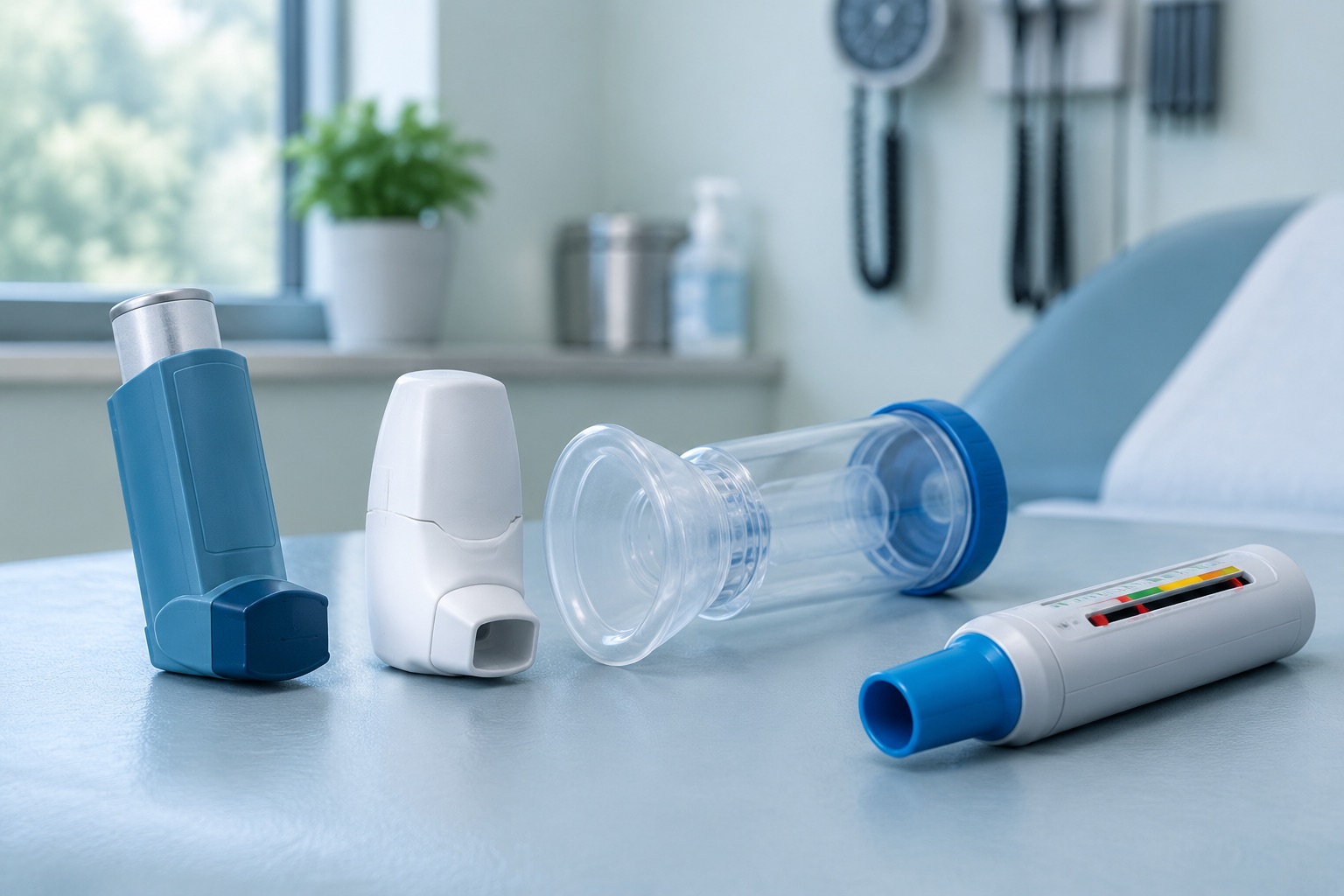
Propellant physics and per-actuation arithmetic: HFA-134a, HFA-227ea, and dry powder
In our respiratory prescribing carbon ledger, pressurized metered-dose inhalers occupy a unique position in healthcare decarbonisation. Unlike operating theatre anaesthetic circuits or reverse-osmosis dialysis plants, inhaler emissions do not emerge from hospital boilers or central electrical grids. Nearly all of a pMDI canister's climate impact comes from the liquefied hydrofluoroalkane (HFA) propellant expelled directly into ambient air every time a patient depresses the valve, as well as residual gas vented after disposal.
Two propellants dominate legacy formularies globally. HFA-134a (1,1,1,2-tetrafluoroethane), used in most salbutamol rescue canisters and many beclomethasone preventers, carries a 100-year global warming potential (GWP100) of roughly 1,430 relative to carbon dioxide. HFA-227ea (1,1,1,2,3,3,3-heptafluoropropane), used in certain fluticasone propionate and combination canisters, carries a GWP100 of 3,220. Consequently, a single 200-actuation salbutamol HFA-134a canister emits roughly 28 kg CO₂e over its clinical lifecycle, whereas an equivalent blistered dry powder inhaler (DPI) or soft mist inhaler (SMI) emits 0.5 to 1.5 kg CO₂e across manufacturing, foil packaging, and disposal, representing a 20 to 40-fold reduction.
In real-world prescribing, that device gap translates into substantial annual patient totals. A nine-clinic primary care audit in eastern Singapore published in npj Primary Care Respiratory Medicine (2025) tracked dispensed inhaled corticosteroids (ICS) and short-acting beta2-agonist (SABA) rescue canisters from 2015 to 2023. Patients dispensed fluticasone propionate pMDIs generated the highest individual annual footprint at 227 kg CO₂e per patient per year, driven by propellant GWP and concomitant SABA utilization. Over the nine-year observation window, as the proportion of patients achieving good asthma control (Asthma Control Test score of 20 or higher) rose from 53.6 percent to 82.5 percent, per-patient greenhouse gas emissions fell from 173 kg CO₂e to 140 kg CO₂e annually.
Direct switching data confirm that carbon savings are achievable without sacrificing symptom scores when patient selection is clinically appropriate. In a post-hoc analysis of a 12-week real-world, non-interventional cohort published in Pulmonary Therapy (2025) covering 237 adults (142 with asthma, 95 with COPD) switched from a pMDI to a budesonide-formoterol Easyhaler DPI, all measured clinical outcomes (ACT, Mini-AQLQ, spirometry, CAT, and mMRC dyspnoea scale) improved significantly (p < 0.001), while SABA rescue demand fell among asthma patients (p < 0.001). Annual maintenance emissions dropped by 97.0 percent and asthma reliever emissions by 99.6 percent, yielding approximately 131 kg CO₂e saved per patient per year.
Global utilization remains heavily skewed toward pressurized canisters despite these numbers. According to a 60-country IQVIA MIDAS analysis published in Pulmonary Therapy (2026), pMDIs accounted for 77.3 percent of total global inhaler actuations in 2022 and exceeded 50 percent of inhaler volume in 51 of 55 countries with complete national data. In Europe alone, an estimated 8.1 million patients relied on maintenance pMDIs, creating acute supply vulnerability as European Chemicals Agency (ECHA) PFAS restriction proposals intersect with F-gas phase-downs.
Why disease control drives carbon more than canister plastic
Early sustainability campaigns often framed inhaler decarbonisation as a binary hardware swap: replace blue and brown pMDIs with dry powder devices across entire primary care registries. Subsequent large-scale epidemiology has corrected that oversimplification. The primary determinant of respiratory prescribing emissions in real-world populations is not merely the device on the shelf, but whether the patient's underlying airway inflammation is adequately controlled.
The landmark UK SABINA CARBON retrospective cohort published in Thorax (2024) analyzed 236,506 asthma patients aged 12 years and older in the Clinical Practice Research Datalink between 2008 and 2019. Nearly half of the cohort (47.3 percent) had poorly controlled asthma at baseline, defined as three or more SABA canisters per year or at least one exacerbation. Scaled nationally, UK asthma management generated 750,540 tonnes CO₂e per year, of which 303,874 tonnes CO₂e per year constituted excess emissions attributable to suboptimal control, equivalent to the annual energy footprint of more than 124,000 UK households. Per capita, poorly controlled asthma generated a 3.1-fold higher overall carbon footprint and an 8.1-fold higher excess carbon footprint than well-controlled asthma, driven overwhelmingly by frequent SABA pMDI dispensing.
Economic and clinical modelling reinforces that same link between symptom stability and carbon intensity. A UK pathway cost-of-illness assessment in ERJ Open Research (2024) valued the 2022 to 2031 net present burden of asthma at £47 billion, noting that uncontrolled non-severe asthma incurred 22 percent higher NHS direct costs and an extra 0.1 tonnes CO₂e per patient annually, while severe asthma generated 0.54 tonnes CO₂e per patient annually (four times the direct impact of controlled non-severe disease). Similarly, in the Singapore primary care cohort, patients with ACT scores below 20 emitted 30 kg CO₂e more per year than well-controlled peers (p < 0.001).
In chronic obstructive pulmonary disease (COPD), real-world comparative effectiveness data now align clinical superiority with lower propellant burden. A 1:1 propensity-score matched cohort study of 20,388 pairs of new single-inhaler triple therapy initiators published in The BMJ (2024) compared twice-daily budesonide-glycopyrrolate-formoterol via pMDI against once-daily fluticasone-umeclidinium-vilanterol via DPI. Patients initiated on the pMDI experienced a 9 percent higher hazard of moderate or severe COPD exacerbation (hazard ratio 1.09, 95% CI 1.04 to 1.14; number needed to harm 38) and a 29 percent higher hazard of severe exacerbation (HR 1.29, 95% CI 1.12 to 1.48; NNH 97), with identical pneumonia hospitalization risk (HR 1.00). Selecting the once-daily DPI in eligible COPD candidates improved both clinical outcomes and emissions simultaneously.
| Inhaler Class & Propellant | Propellant GWP100 & Carbon | Inspiratory Flow Gate (PIFR) | Clinical Evidence Summary | Prescribing Safety Gate |
|---|---|---|---|---|
| Dry Powder Inhaler (DPI) No hydrofluoroalkane gas |
GWP 0 -97.0% maint / -99.6% reliever |
PIFR ≥ 30 to 60 L/min Device-resistance dependent |
In 237 switched asthma/COPD patients (Pulmonary Therapy 2025), ACT, CAT, and mMRC improved (p < 0.001) while cutting ~131 kg CO₂e/yr. In 20,388 COPD pairs (BMJ 2024), DPI triple therapy had fewer exacerbations than pMDI. | Confirm adequate inspiratory effort using an In-Check Dial or clinical teach-back before switching. Avoid during acute severe dyspnoea or frail low-PIFR phenotypes. |
| Legacy Salbutamol pMDI HFA-134a propellant |
GWP 1,430 ~28 kg CO₂e / canister |
Slow, steady (~30 L/min) Active aerosol plume |
Excess SABA prescribing (≥3 canisters/yr) drove 303,874 t CO₂e/yr in UK SABINA CARBON (Thorax 2024). Still represents 77.3% of global inhaler doses across 60 countries (Pulmonary Therapy 2026). | Never withdraw abruptly without clinical alternative. Pair with valved holding chamber spacer for children under 10 years, elderly coordination limits, or emergency rescue. |
| High-GWP ICS/LABA pMDI HFA-227ea propellant |
GWP 3,220 Up to 227 kg CO₂e / yr |
Slow, steady (~30 L/min) Spacer recommended |
Fluticasone propionate pMDIs produced the highest annual per-patient emissions (227 kg CO₂e/yr) in a 9-clinic Singapore audit (npj Prim Care Respir Med 2025). | Highest priority for structured clinical review toward DPI or low-GWP ICS-formoterol MART where inspiratory flow and dexterity allow. |
| Next-Gen Propellant pMDI HFA-152a (under EMA review) |
GWP ~124 ~92% propellant cut |
Identical to HFA-134a Zero technique change |
Phase III bioequivalence reported for salbutamol HFA-152a (EMA filing 2026). Preserves identical canister actuation for low-PIFR patients who lose 65 to 70% of savings under forced DPI switches (CMRO 2026). | Await national formulary launch (targeted from 2027). Do not delay SABA reduction or MART optimization while waiting for next-generation canisters. |
The inspiratory flow and forced-switch safety gate
Dry powder inhalers and pressurized metered-dose inhalers operate on opposite aerodynamic principles. A pMDI uses pressurized propellant vaporization to create a high-velocity aerosol cloud; the patient must coordinate actuation with a slow, steady inhalation (roughly 30 L/min) or use a valved holding chamber spacer to reduce oropharyngeal impaction. By contrast, a DPI is breath-actuated: the patient must generate a rapid, forceful initial inhalation against the device's internal resistance to de-agglomerate micronized drug particles from lactose carrier spheres.
Depending on internal resistance, effective lung deposition typically requires a peak inspiratory flow rate (PIFR) of at least 30 L/min for high-resistance reservoirs (such as Easyhaler or HandiHaler) and 50 to 60 L/min for medium-to-low resistance devices (such as Diskus or Turbuhaler). When health systems execute blanket, non-clinically driven formulary switches without testing PIFR or teaching inhalation technique, clinical control deteriorates. As documented in Current Medical Research and Opinion (2026) across UK, Swedish, and Danish models, non-clinically driven DPI switch policies lost 65 to 70 percent of their anticipated carbon savings to acute exacerbations, emergency clinic attendances, and rescue therapy prescriptions.
An international call to action from the IRIS group in the European Respiratory Journal (2026) emphasizes that 48 percent of the more than 650 million people living with asthma or COPD worldwide rely on pMDIs, and that vulnerable groups cannot safely be forced onto dry powder devices. Specifically, children under 10 years old, patients experiencing acute dyspnoea or emergency bronchospasm, frail older adults with sarcopenia or hyperinflation, and patients in low-resource clinics without spacer access depend on active-plume pMDIs or soft mist inhalers. Furthermore, as Pulmonary Therapy (2026) notes in evaluating proportionate risk and reward, national policy must pair voluntary DPI transition with regulatory clearance of near-zero-GWP propellants such as HFA-152a (GWP ~124, roughly 92 percent lower climate impact, already covered in our HFA-152a Ventolin filing note) and HFO-1234ze so patients who require a pressurized canister are never left behind.
Real-world national dashboards illustrate why clinical suitability defines the ceiling for pure DPI share targets. As detailed in our review of NHS Wales inhaler metrics, Wales cut total inhaler emissions by 45 percent between January 2022 and January 2026 (from 65.8 million kg to 36.9 million kg CO₂e annually) through SABA reduction and targeted reviews, even though its aspirational 80 percent low-carbon prescription share was not reached. Counting every patient who legitimately needs a pMDI plus spacer as a failure misreads respiratory safety.
Departmental prescribing ledger: four operational steps for primary care
For general practitioners, respiratory pharmacists, and primary care clinical leads updating sustainable primary care protocols, the combined clinical and life-cycle evidence supports four concrete workflow steps:
- Flag high-SABA cohorts before targeting maintenance devices: Query electronic prescribing records for patients collecting three or more SABA pMDI canisters over 12 months. Converting poorly controlled SABA-reliant patients onto anti-inflammatory ICS-formoterol maintenance and reliever therapy (MART) addresses the 3.1-fold to 8.1-fold excess carbon burden identified in SABINA CARBON while preventing hospital admissions.
- Measure inspiratory capacity and hand-breath coordination at annual review: Never switch a patient from pMDI to DPI by bulk letter or automated pharmacy substitution. Use an In-Check Dial or clinical teach-back assessment during face-to-face review to verify that the patient can achieve the minimum PIFR required for the chosen DPI resistance profile.
- Prioritize HFA-227ea and once-daily COPD opportunities first: Audit registries for high-GWP HFA-227ea fluticasone canisters (227 kg CO₂e/yr benchmark) and COPD patients on twice-daily triple pMDIs who qualify for once-daily DPI triple therapy, where real-world data demonstrate lower exacerbation rates alongside lower emissions.
- Protect pMDI plus spacer access for excluded populations: Explicitly exempt children under 10 years, patients with severe cognitive or neuromuscular impairment, and rescue-cart emergency protocols from DPI conversion targets, and ensure used canisters enter pharmacy recovery schemes rather than unsealed landfill disposal.