The email landed on a Friday. A pharmacist in a respiratory clinic we correspond with forwarded the GSK statement with one line above it: "does this change what I tell patients?" The statement, dated 4 September, said the company had filed with European regulators for a next-generation Ventolin whose propellant, HFA-152a, cuts the inhaler's carbon by roughly 92%. If approved, first launches in 2027.
The honest answer to her question is: not yet, and not for a while. But the filing deserves more attention than it got, because it is the first time the biggest single object in respiratory medicine's carbon problem — the blue reliever, 300 million of them sold a year — has a like-for-like replacement moving through a serious regulator.
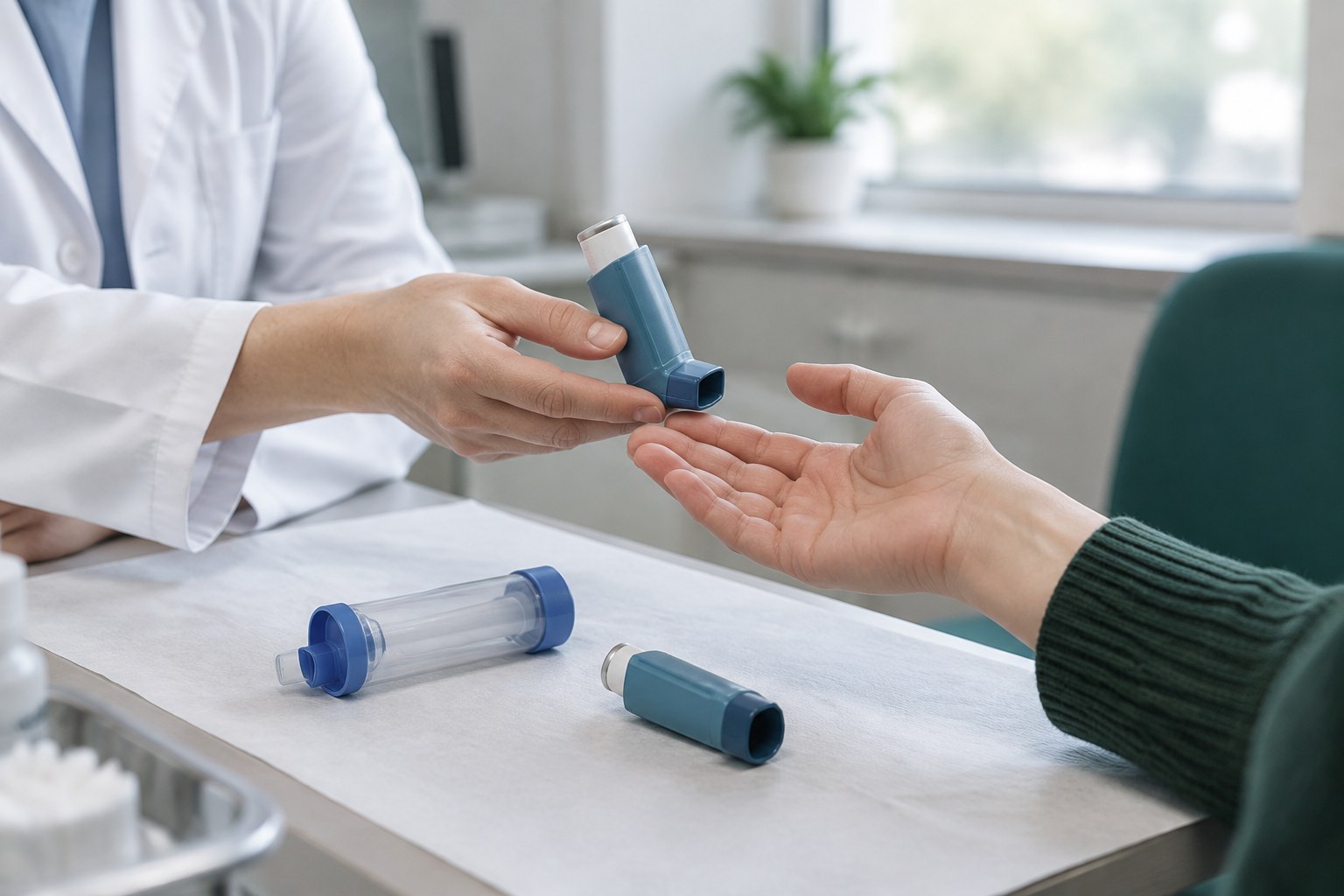
Why the blue inhaler is the whole game
Start with the scale, because it explains the silence. GSK's own annual report puts this one product at 43% of the company's entire carbon footprint. Not its respiratory line: the whole company, factories and fleets included. HFA-134a, the propellant inside essentially every metered-dose reliever on Earth, has a 100-year global warming potential of about 1,300; HFA-152a sits near 15. The arithmetic is not controversial. What has been missing for a decade is a swap that regulators would accept without asking patients to change anything.
That is the design philosophy worth naming. The phase III programme did not try to improve the drug; it tried to prove nothing changes. Two studies published this year — a bioavailability trial in 60 healthy adults and a methacholine-challenge potency study in 21 patients with mild asthma — both landed inside standard bioequivalence bounds, with no serious treatment-related events. Same canister, same counter, same shake-and-breathe. The success condition is invisibility.
What a filing is, and what it is not
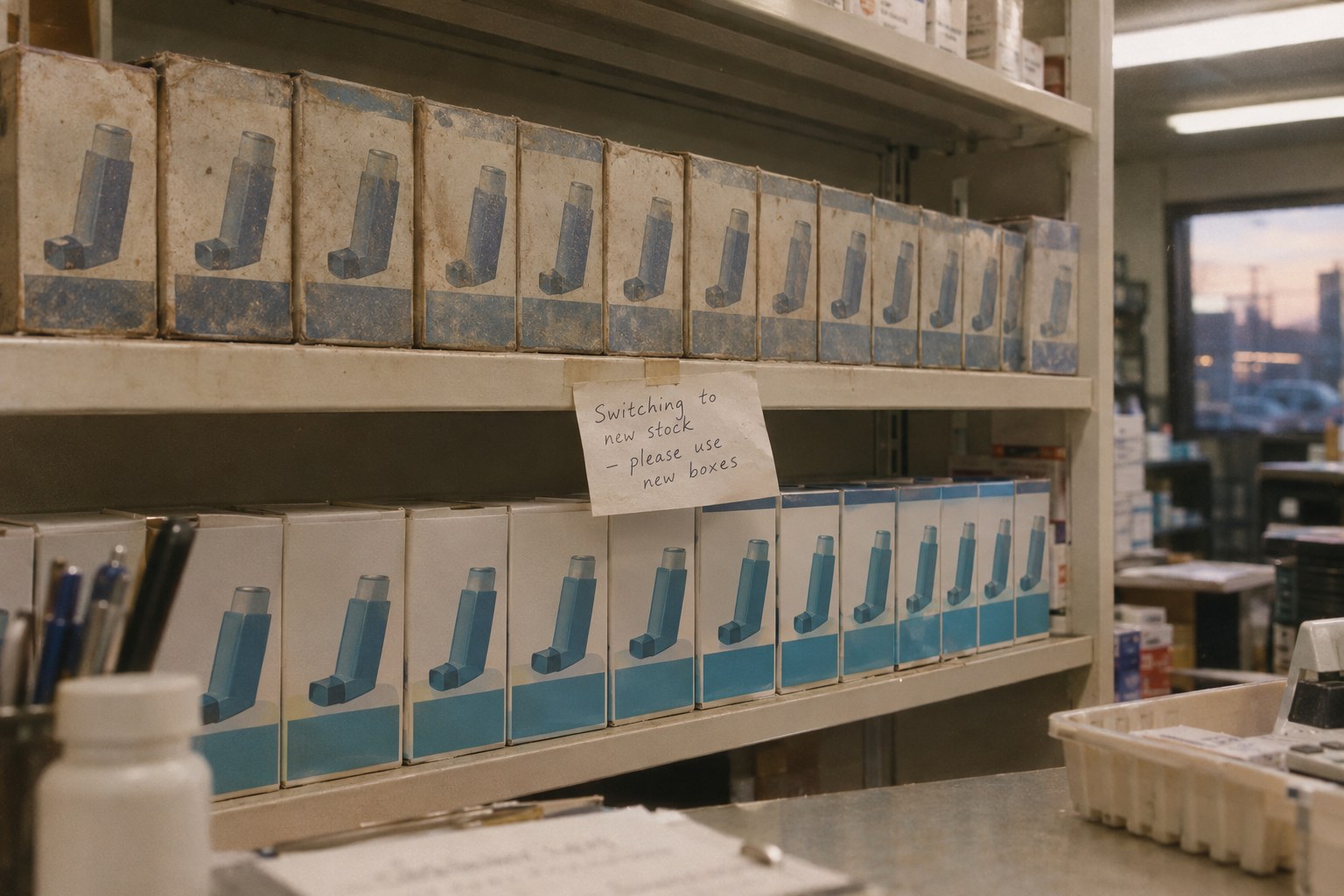
A regulatory submission is the start of a corridor, not the end of one. No EMA opinion yet, no price, no country list, and GSK's own guidance is launches "from 2027" if approved. For planning purposes the right posture is the CFC transition of the 1990s: both canisters in pharmacies side by side for years, prescriptions crossing over one patient at a time.
Three pressure points make this more than one company's ESG line. NHS England has twice signalled it would delist high-GWP inhalers once credible low-GWP alternatives exist — this filing is the first concrete trigger for that threat. Chiesi's near-carbon-neutral K-haler and the Aim initiative proved the sector can move. And the counter-evidence we carry on our own inhalers page stands: forced DPI switches that ignored clinical eligibility lost 65–70% of their projected savings to exacerbations. A like-for-like propellant swap sidesteps that trap entirely — nothing about the patient's technique changes, so nothing about their control does either.
Which loops back to the pharmacist's question. What she tells patients in 2026 is unchanged: a reliever is not a safety net to lean on three times a day, and no propellant will ever fix an over-prescribed rescue inhaler. What changes is what she can tell her procurement team in 2027 — and that is worth a Friday email.