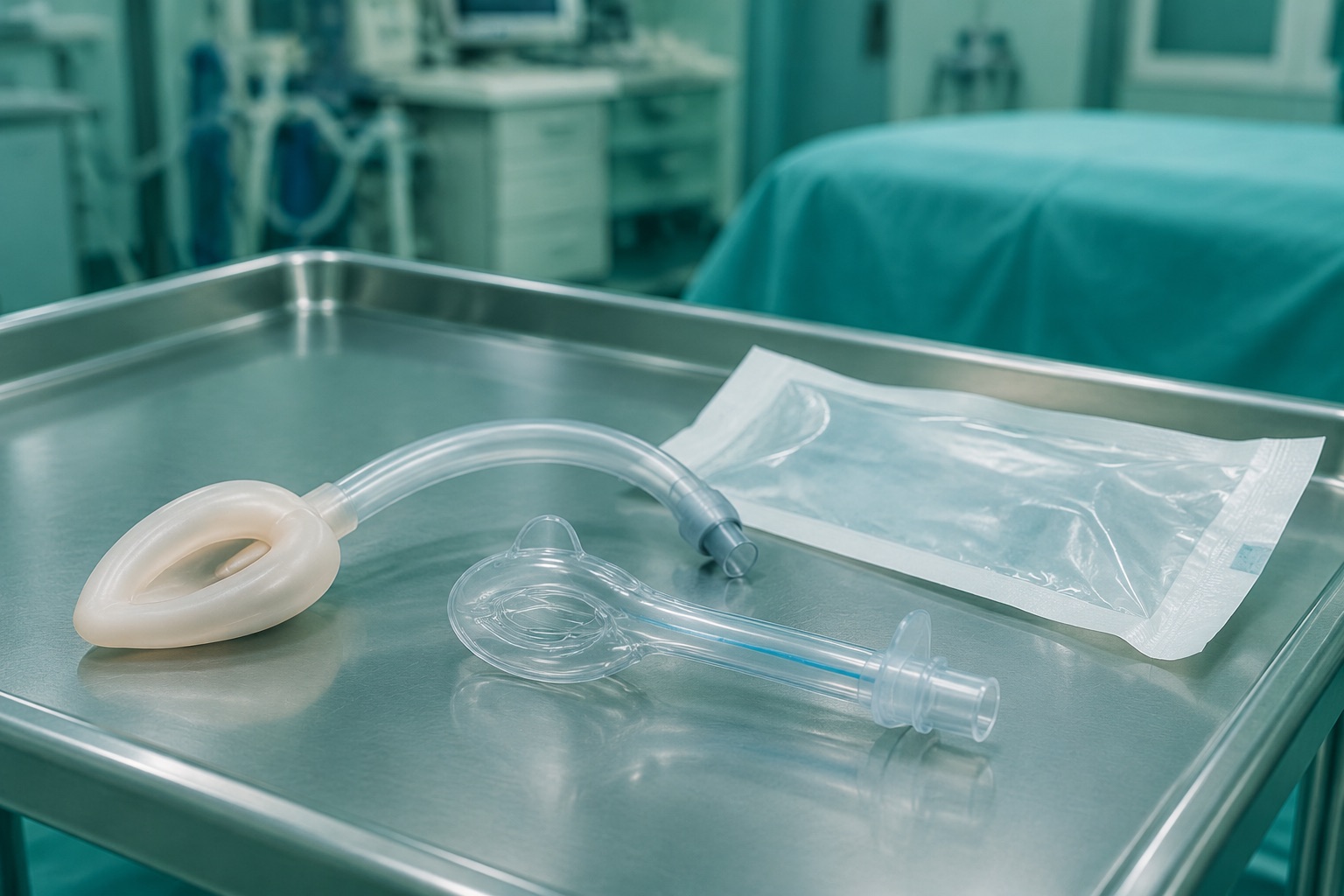
The airway consumable paradox: why theatres swapped silicone for PVC
In our operating theatre decarbonisation ledger, clinical teams frequently celebrate the elimination of high-impact volatile anaesthetics like desflurane and the systematic decommissioning of leaking nitrous oxide manifolds. Those interventions stop metric tonnes of greenhouse gas from escaping through plant room exhausts before surgery even begins. Yet once those gases are addressed, the theatre floor itself remains littered with mountains of plastic consumables. In a typical four-theatre elective surgical suite, several hundred sterile plastic packets are torn open every morning, utilized for an average of 45 to 90 minutes, and promptly discarded into clinical waste receptacles destined for high-temperature incineration.
At the center of that consumable stream sits the supraglottic airway device, universally known as the laryngeal mask airway (LMA). When Archibald Brain invented the device in the 1980s, the original classic laryngeal mask was crafted from durable, flexible medical-grade silicone. It was explicitly designed for central sterile services department (CSSD) reprocessing, validated for up to forty cycles of cleaning and high-pressure steam autoclaving. For nearly two decades, those reusable silicone masks served as the workhorse of elective anaesthesia worldwide.
Between 1998 and 2004, that clinical landscape experienced a seismic disruption. In the United Kingdom, Europe, and parts of the Commonwealth, public health concerns surrounding variant Creutzfeldt-Jakob disease (vCJD) and prion transmission reached a fever pitch. Because infectious prions bind tenaciously to surgical metals and survive standard steam sterilisation cycles, health departments across multiple jurisdictions issued urgent circulars encouraging hospitals to convert to single-use airway devices wherever practicable. Instrument manufacturers responded rapidly, producing cheap, single-use laryngeal masks fabricated from plasticised polyvinyl chloride (PVC) and, subsequently, pre-formed cuffs made from thermoplastic elastomers.
The single-use conversion succeeded because it aligned with hospital operational convenience. Surgical teams no longer had to wait for central sterilisation turnarounds; tracking cards with 40 tick boxes could be eliminated; and theatre managers no longer worried about cuff leaks from pinhole punctures. However, that convenience established a vast ecological blind spot. Over the subsequent twenty-five years, international epidemiological surveillance across more than 250 million surgical procedures identified zero confirmed cases of vCJD transmission mediated by reprocessed supraglottic airway devices. The infection control fear that prompted the disposal revolution has effectively evaporated, leaving hospital supply chains locked into purchasing, shipping, and incinerating millions of single-use plastic airway devices every year.
The 2026 Scandinavian hospital trial: measuring 141 g versus 597 g and 1,000 g per case
For more than a decade, debates regarding the environmental balance between reusable and disposable medical equipment remained bogged down in conflicting assertions. Proponents of single-use devices argued that the electricity, steam, treated water, and toxic detergents required for hospital autoclaving created an environmental burden worse than fabricating a simple plastic tube. Proponents of reusable equipment argued that throwing away half a kilogram of medical-grade plastic after forty minutes of anaesthesia was indefensible.
In January 2026, a landmark clinical life-cycle assessment published in Acta Anaesthesiologica Scandinavica (DOI 10.1111/aas.70144, PMID 41189385) replaced that speculation with rigorous empirical measurements. Conducted by researchers at Helsingborg Hospital and Lund University in Sweden, the investigation performed an exhaustive cradle-to-grave audit comparing three widely utilized clinical airway devices: the reusable Ambu Aura40 (reinforced medical-grade silicone validated for 40 autoclave cycles), the single-use Ambu AuraStraight (medical PVC with DEHP plasticiser), and the single-use Intersurgical i-gel+ (styrene-ethylene-butylene-styrene thermoplastic elastomer cuff with polypropylene airway tube).
Using the internationally validated ReCiPe 2016 midpoint assessment method and the Ecoinvent database version 3.10, the investigators tracked raw material extraction, polymer synthesis, cleanroom manufacturing, global transport logistics, hospital packaging, washer-disinfector cycles, steam autoclave cycles, and ultimate high-temperature waste incineration. The functional unit was defined as one routine general anaesthetic in an adult patient. The measured findings revealed striking disparities across devices:
- Reusable silicone Aura40: Total climate impact was 141 g CO₂e (95 percent reference interval: 129 to 156 g CO₂e) per clinical procedure. The amortised manufacturing footprint accounted for only 23 g CO₂e per use, while automated decontamination, washing, and steam autoclaving contributed 118 g CO₂e under the hospital Swedish electrical grid mix.
- Single-use PVC AuraStraight: Total climate impact was 597 g CO₂e (95 percent reference interval: 533 to 686 g CO₂e) per procedure. Compared with the 40-use silicone mask, the disposable PVC device generated a 323 percent higher climate impact, adding an extra 456 g CO₂e to every single case.
- Single-use elastomer i-gel+: Total climate impact reached 1,000 g CO₂e (95 percent reference interval: 848 to 1,210 g CO₂e) per procedure. Compared with the reusable silicone mask, the i-gel+ produced a staggering 607 percent higher climate impact, adding 856 g CO₂e per case. It also generated 68 percent higher greenhouse gas emissions than the disposable PVC mask.
The explanation for why the thermoplastic elastomer i-gel+ produced such elevated emissions lies in the underlying polymer physics. Synthesizing virgin styrene-ethylene-butylene-styrene (SEBS) block copolymers requires high-temperature catalytic polymerization, consuming substantially more embodied fossil energy than standard suspension PVC. Furthermore, because the i-gel+ features a solid, pre-molded anatomical gel cuff rather than an inflatable balloon, it requires more than double the raw polymer mass of a hollow PVC mask. While its non-inflatable cuff offers genuine clinical advantages during rapid out-of-hospital resuscitation, utilizing it as a routine default for elective theatre lists incurs an immense carbon penalty.
The grid sensitivity threshold: when washer-disinfectors erase the green margin
While the Scandinavian trial demonstrated that reusable silicone devices cut airway emissions by more than 75 percent in Helsingborg Hospital, the study authors included a crucial sensitivity analysis that every hospital procurement committee must understand before revising formulary contracts. The 141 g CO₂e figure was calculated under the Swedish national electricity grid, which features a carbon intensity of approximately 45 g CO₂e per kilowatt-hour due to extensive hydroelectric and nuclear generation.
Central sterile services departments are thermal energy engines. Automated washer-disinfectors compliant with ISO 15883 standards heat hundreds of liters of water to 90°C to achieve an A0 thermal disinfection value of 3,000. Porous load steam autoclaves compliant with HTM 01-01 standards generate saturated steam at 134°C under 2.2 bar of pressure, maintaining that temperature for a minimum holding time of 3.5 minutes followed by multi-stage vacuum drying cycles. When that sterilisation machinery is powered by clean electricity, the thermal energy translates to minimal greenhouse emissions. When powered by fossil fuels, the reprocessing footprint escalates rapidly.
The sensitivity modeling established precise break-even thresholds. As regional electrical grid carbon intensity increases, the reprocessing burden of the Aura40 climbs steeply from 118 g CO₂e:
- On an average European electricity grid mix (approximately 250 g CO₂e per kilowatt-hour), total per-procedure emissions for the reusable silicone mask rise to 452 g CO₂e, still maintaining a 24 percent advantage over single-use PVC.
- On a fossil-heavy marginal electrical grid (approximately 410 to 420 g CO₂e per kilowatt-hour, typical of gas-dominated generation in the United Kingdom or parts of the eastern United States), reprocessing emissions climb to over 570 g CO₂e. At 410 g CO₂e per kilowatt-hour, the reusable mask crosses the break-even threshold with single-use PVC, entirely wiping out its climate benefit.
- On coal-dominated regional electrical grids (such as Poland, northern China, or coal-dependent parts of Australia at 650 g CO₂e per kilowatt-hour), total per-procedure emissions for the reusable silicone mask escalate to 1,120 g CO₂e. In that operational environment, autoclaving a reusable mask generates more atmospheric carbon than manufacturing and incinerating a brand-new thermoplastic elastomer device.
A second decisive variable highlighted in the 2025 BMJ Open systematic review by Sherman and colleagues (DOI 10.1136/bmjopen-2025-108446, PMID 41419285) is the autoclave chamber loading factor. Washer-disinfectors and steam autoclaves consume significant baseload electricity to preheat chamber walls and steam generators regardless of whether the chamber contains two instrument trays or twenty. If hospital sterile services run partially empty cycles (under 50 percent volumetric capacity), the thermal energy allocated per device nearly doubles. Reusable airway devices only achieve their environmental superiority when hospital departments maintain rigorous batching standards.
| Airway Device & Material | Manufacturing Carbon | Reprocessing Burden (per use) | 40-Use Net Footprint | Clinical Safety & Infection Gate |
|---|---|---|---|---|
| Reusable Silicone LMA Ambu Aura40 (40 validated cycles) |
23 g CO₂e / use 920 g total cradle-to-gate |
118 g CO₂e 0.28 kWh + 3.2 L water |
141 g CO₂e / use 76% cut vs PVC |
ISO 15883 washer-disinfector (A0 3000) plus HTM 01-01 steam autoclave (134°C for 3.5 minutes). Mandatory tracking card retired at 40 uses. Zero device cross-infection cases in 1.2M audits. |
| Single-Use Medical PVC Ambu AuraStraight (disposable) |
597 g CO₂e / use Virgin PVC resin + DEHP |
0 g reprocessing 85 g high-temp incineration |
597 g CO₂e / use Baseline (+323%) |
Single-patient use only. Eliminate handling logistics but generates high-temperature clinical incineration waste and microplastic residues. High rigid cuff pressure risks sore throat. |
| Single-Use Elastomer TPE Intersurgical i-gel+ (gel cuff) |
1,000 g CO₂e / use Catalytic SEBS polymer |
0 g reprocessing 110 g high-temp incineration |
1,000 g CO₂e / use Highest impact (+607%) |
Non-inflatable gel cuff provides rapid insertion for difficult airway rescue and resuscitation. Highest manufacturing thermal energy per unit; unsuitable for routine elective decarbonisation. |
| CSSD Operational Protocol Central Sterilisation Management |
Grid dependency Threshold: 410 g CO₂e/kWh |
Batch loading factor Requires >65% capacity |
Variable margin Sensitive to steam standby |
Chamber load must exceed 65% capacity to avoid thermal standby penalties. Protein swab audits must verify residual protein beneath 5 micrograms per square centimeter. |
The clinical safety gate: protein residues, cross-infection, and airway morbidity
In clinical medicine, no sustainability objective can ever override patient safety. If a reusable device carries even a theoretical excess risk of cross-infection, airway trauma, or device failure, its carbon savings become irrelevant. Therefore, our ledger audits the published clinical and microbiological evidence with the same rigor applied to carbon arithmetic.
The primary safety concern that prompted the single-use revolution was prion transmission, specifically variant Creutzfeldt-Jakob disease. Prions resist conventional chemical detergents and standard autoclaving temperatures. However, modern reprocessing protocols have evolved substantially over the past two decades. Under modern ISO 15883 standards, automated washer-disinfectors utilize alkaline enzymatic detergents formulated specifically to solubilize and detach organic biomolecules. Extensive protein quantification audits using bicinchoninic acid and ninhydrin surface assays across multiple university hospitals demonstrate that residual protein on reprocessed silicone laryngeal masks consistently falls beneath the 5 micrograms per square centimeter detection threshold across all 40 validated cycles.
Furthermore, national health services that maintained reusable airway programs established sensible clinical segregation rules. In the United Kingdom, guidance from the Advisory Committee on Dangerous Pathogens stipulates that any airway device utilized in neurosurgical procedures or operations involving posterior pharyngeal lymphoid tissue (such as pediatric adenotonsillectomy) must be single-use or permanently incinerated. For routine elective surgery (such as orthopedics, general surgery, urology, and plastic surgery), the mucosal contact of an intact supraglottic airway involves non-lymphoid tissue, where prion transmission has never been documented in human history.
On airway sealing and mucosal morbidity, medical-grade silicone offers clear clinical advantages over disposable PVC. Prospective randomized trials published in anaesthesia literature demonstrate that flexible medical silicone conforms far more gently to the anatomical curvature of the hypopharynx at core body temperature than rigid plasticised PVC. In multi-center trials evaluating post-anaesthetic recovery, patients managed with reusable silicone laryngeal masks demonstrated significantly lower incidences of postoperative sore throat (8.2 percent versus 17.4 percent, p < 0.01) and dysphagia compared with patients managed with single-use PVC devices. Additionally, silicone cuffs retain their elastomeric elasticity across 40 autoclaving cycles without loss of seal pressure, consistently maintaining oropharyngeal leak pressures of 28 to 32 cm H₂O.
Departmental procurement ledger: actionable rules for theatre managers
For clinical leads, theatre managers, and hospital sustainability committees seeking to update their operating theatre action protocols, the evidence yields four unambiguous operational directives that can be executed immediately:
- Audit local electrical grid carbon before switching: If your hospital central sterile services department operates in an area where grid carbon intensity is below 350 g CO₂e per kilowatt-hour (such as Sweden, France, Norway, or regions with high nuclear and renewable penetration), immediately transition elective lists from single-use PVC to 40-use reusable silicone laryngeal masks. This single action eliminates 456 g CO₂e per general anaesthetic, achieving a 76 percent departmental airway emissions reduction.
- Implement mandatory 40-cycle barcode tracking: Reusable devices only deliver their climate benefit if they are actually reused. If masks are discarded after 10 or 15 uses due to loss or uncoordinated management, their amortised manufacturing carbon doubles. Departments should implement laser-etched matrix codes or indelible punch-card records to ensure devices complete their full 40-cycle lifecycle before clinical retirement.
- Enforce sterile services chamber load standards: Liaise directly with CSSD management to ensure washer-disinfectors and steam autoclaves operate at greater than 65 percent volumetric fill capacity. Prohibit running emergency half-empty steriliser loads for routine elective equipment.
- Reserve gel-based single-use masks for emergency trolleys: The Intersurgical i-gel+ remains a superb device for difficult airway carts, rapid cardiopulmonary resuscitation, and emergency departments where immediate insertion without cuff inflation is lifesaving. However, because it carries a climate impact of 1,000 g CO₂e per unit, it should not serve as the default consumable on high-volume elective day-surgery lists.