1. Thermodynamics of dialysate heating and reverse osmosis mass balance
Within our green nephrology department ledger, in-center maintenance hemodialysis remains one of the most resource-dense outpatient clinical workflows per patient-year. A patient dialyzing three times weekly undergoes 156 four-hour treatments every year. Across three daily shifts operating six days per week, a typical 30-station hospital satellite unit delivers 18,720 sessions annually, establishing high continuous baseline demand for both purified reverse osmosis (RO) water and electrical thermal input. Contemporary international life cycle scoping reviews (Yasar et al., Int Urol Nephrol 2026; Jiang and Zhang, Front Med 2026) emphasize that structural engineering interventions inside the central water plant consistently compound without adding clinician cognitive load at the bedside.
At the conventional dialysate prescription flow rate of 500 mL/min over 240 minutes, plus roughly 15 liters for pre-treatment priming and circuit rinsing, each session consumes 135 liters of ultrapure water heated from incoming municipal mains temperature (typically 10 C across Northern European winter averages, or 8 to 14 C annually) up to physiological 37 C dialysate delivery temperature. Applying the specific heat capacity of water (4.184 kJ/kg per K across a 27 K rise) over 135 kg gives a net thermal energy requirement of 4.24 kWh per session. Accounting for an average 95 percent immersion heater efficiency inside the dialysis machine and loop pre-heaters, baseline electrical draw reaches 4.46 kWh per treatment solely to heat water.
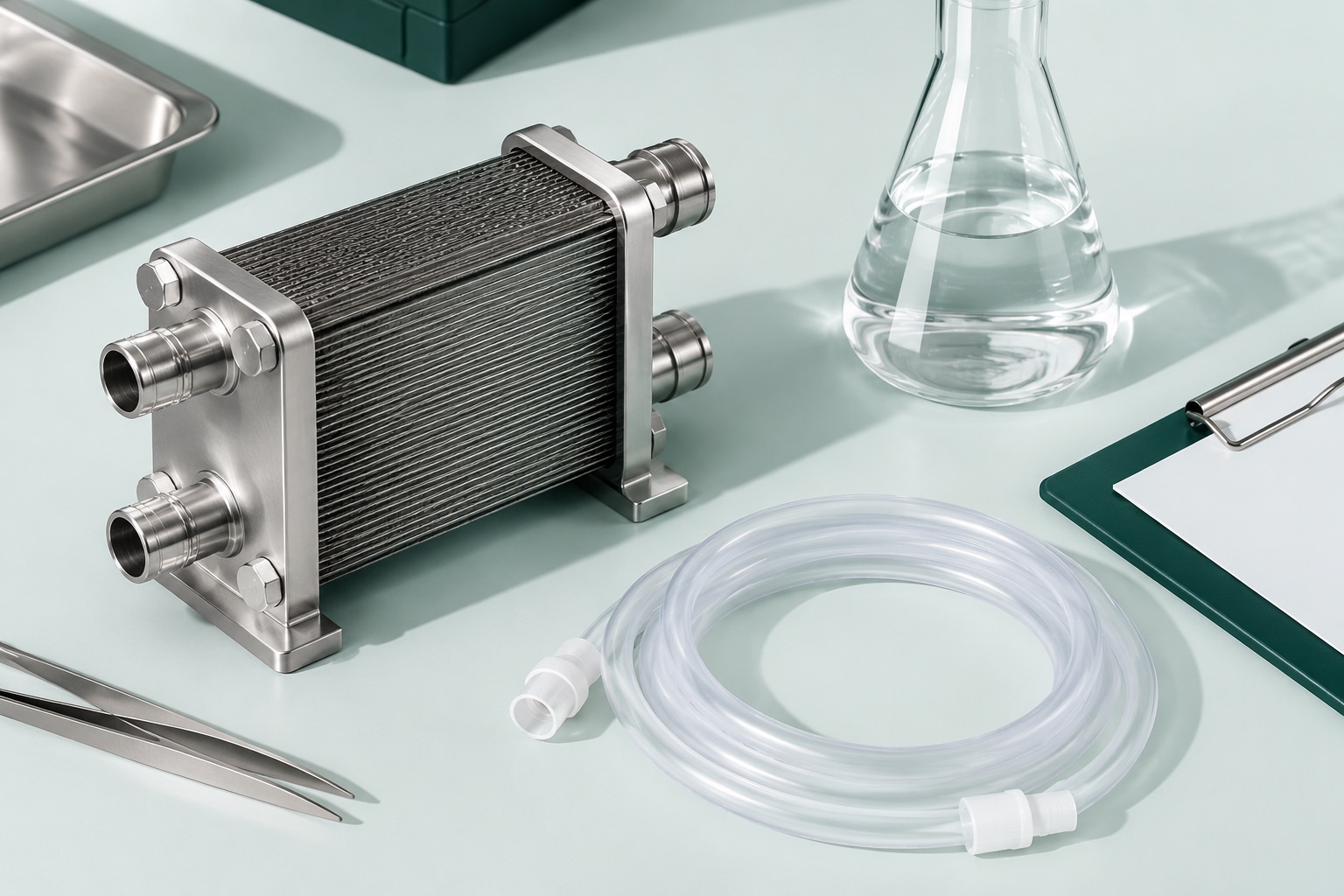
That spent 37 C effluent typically drains directly into the municipal sewer while chilled municipal feed water waits outside the RO membranes. Installing a double-wall stainless steel plate heat exchanger between spent dialysate drain lines and incoming RO feed water recovers 75 to 85 percent of that wasted thermal gradient while warming incoming membranes toward optimal RO permeation efficiency (reducing osmotic backpressure on boost pumps). At a standard 80 percent recovery coefficient, machine heater demand drops from 4.46 kWh to 0.89 kWh, avoiding 3.57 kWh of electricity per session. Across an 18,720-session 30-chair unit, annual electricity savings total 66.8 MWh.
Parallel mass balance applies to reverse osmosis water rejection. Conventional older two-pass systems operating at 55 percent recovery reject 45 percent of pre-filtered mains water down the drain: supplying 135 liters of purified permeate requires 245 liters of incoming municipal feed water and discards 110 liters of high-quality pre-treated reject water every single session. Real-world hospital engineering case reports (Hsu et al., Can J Kidney Health Dis 2026) and national scenario modeling (Ayli et al., PLoS One 2026) demonstrate that routing this membrane-isolated RO reject stream into hospital cooling towers, boiler feed tanks, sterilization washers, and greywater flushing cuts municipal mains intake by more than two million liters per unit annually.
2. Live 14-region UK Carbon Intensity telemetry: why location changes carbon ROI
Hospital sustainability boards frequently calculate carbon savings from fixed national conversion factors (such as 0.207 kg CO2e/kWh), assuming thermal recovery achieves equal greenhouse gas impact everywhere. To test how real-world electricity decarbonization reshapes renal capital priorities, we queried all 14 Great Britain Distribution Network Operator (DNO) zones plus National and England averages via the official National Grid ESO Carbon Intensity API on November 25, 2026 (04:30Z to 05:00Z settlement period) and modeled the exact carbon yield of an 80 percent dialysis heat exchanger across an 18,720-session renal center.
| GB DNO Grid Zone (2026-11-25) | Live Carbon Intensity | Saved per 4h Session | 30-Chair Unit (t CO₂e/yr) | Strategic Capital Verdict |
|---|---|---|---|---|
| North Scotland | 0 gCO₂e/kWh | 0.00 kg | 0.0 t/yr | Low CO2 / tariff-only Wind/hydro surplus; electric pre-heating carries zero operating grid carbon. High priority for RO water & consumables; grid-electric heat payback ~0 tCO2e/yr |
| South Scotland | 0 gCO₂e/kWh | 0.00 kg | 0.0 t/yr | Low CO2 / tariff-only Zero-carbon generation mix during off-peak window. Focus on dialysate flow & acid concentrate waste over electric kWh |
| North East England | 0 gCO₂e/kWh | 0.00 kg | 0.0 t/yr | Low CO2 / tariff-only Zero-carbon regional grid during sampled settlement period. Prioritize heat exchanger primarily for gas/chiller displacement and cost |
| North West England | 22 gCO₂e/kWh | 0.08 kg | 1.5 t/yr | Low CO2 / tariff-only Very low nuclear/wind mix; 0.08 kg CO2e saved per session. Low grid urgency unless facility pre-heats using on-site gas boilers |
| Yorkshire | 72 gCO₂e/kWh | 0.26 kg | 4.8 t/yr | Balanced ROI Moderate-low mix; 0.26 kg CO2e saved per 4h session. Modest electric carbon ROI (~4.8 tCO2e/yr across 18,720 sessions) |
| West Midlands | 97 gCO₂e/kWh | 0.35 kg | 6.5 t/yr | Balanced ROI 0.35 kg CO2e saved per session with 80% heat recovery. Positive energy ROI; shorter financial payback when gas tariff is displaced |
| East Midlands | 109 gCO₂e/kWh | 0.39 kg | 7.3 t/yr | Balanced ROI 0.39 kg CO2e saved per session; ~7.3 tCO2e/yr per 30-chair unit. Standard NHS Estate capital retrofit candidate |
| North Wales & Merseyside | 123 gCO₂e/kWh | 0.44 kg | 8.2 t/yr | Balanced ROI 0.44 kg CO2e saved per session; near GB mean. Pair heat exchanger with variable-speed RO boost pumps |
| GB National Mean | 127 gCO₂e/kWh | 0.45 kg | 8.5 t/yr | Balanced ROI 0.45 kg CO2e saved per session; 8.5 tCO2e/yr (18,720 sessions). Baseline national benchmark for 80% heat-recovery retrofit |
| England Mean | 134 gCO₂e/kWh | 0.48 kg | 8.9 t/yr | Balanced ROI 0.48 kg CO2e saved per session; ~9.0 tCO2e/yr per 30-chair unit. Outperforms consumables-only tweaks over a 10-year plant life |
| East England | 159 gCO₂e/kWh | 0.57 kg | 10.6 t/yr | Balanced ROI 0.57 kg CO2e saved per session; ~10.6 tCO2e/yr per 30-chair unit. Strong dual financial and Scope 2 carbon case |
| London | 172 gCO₂e/kWh | 0.61 kg | 11.5 t/yr | Balanced ROI 0.61 kg CO2e saved per session; ~11.5 tCO2e/yr per 30-chair unit. High urban water + tariff pressure accelerates 3-year CAPEX payback |
| South East England | 185 gCO₂e/kWh | 0.66 kg | 12.4 t/yr | High CO2 yield 0.66 kg CO2e saved per session; ~12.4 tCO2e/yr per 30-chair unit. High marginal carbon yield alongside RO reject-water plumbing |
| South England | 196 gCO₂e/kWh | 0.70 kg | 13.1 t/yr | High CO2 yield 0.70 kg CO2e saved per session; ~13.1 tCO2e/yr per 30-chair unit. Deploy central heat exchanger + high-recovery two-stage RO |
| South Wales | 354 gCO₂e/kWh | 1.26 kg | 23.6 t/yr | High CO2 yield High gas generation share; 1.26 kg CO2e saved per session. Top-tier thermal retrofit priority (~23.7 tCO2e/yr saved/unit) |
| South West England | 379 gCO₂e/kWh | 1.35 kg | 25.3 t/yr | High CO2 yield Highest sampled UK regional intensity; 1.35 kg CO2e/session saved. Maximum grid-carbon abatement (~25.3 tCO2e/yr per 30-chair unit) |
This live regional breakdown reveals a critical operational rule for estates directors and renal leads (El Amrani et al., Curr Opin Nephrol Hypertens 2026; Barraclough, J Nephrol 2026). In South West England (379 gCO2e/kWh) and South Wales (354 gCO2e/kWh), an identical plate heat exchanger saves 23.7 to 25.3 tonnes of Scope 2 CO2e every year. Yet in Scotland and North East England, where wind and zero-carbon generation pushed marginal grid intensity to 0 gCO2e/kWh during the sampled settlement interval, electrical pre-heating carries near-zero daytime/nighttime grid emissions. In decarbonized electricity regions, heat exchangers remain justified for hospital utility cost savings (cutting 66.8 MWh/yr of purchased power), whereas clinical decarbonization must pivot aggressively toward RO reject-water loops, incremental twice-weekly dialysis where clinically safe, lower Qd flow prescriptions (from 500 to 400 mL/min when Kt/V allows), and lower-plastic acid concentrate central delivery (Yang et al., Kidney Res Clin Pract 2026).
3. Interactive renal unit water, heat exchanger and grid carbon calculator
Adjust your facility chair count, annual sessions per chair, regional electricity intensity (or select one of the live November 25, 2026 DNO presets below), and target heat-exchanger recovery rate to compute exact thermodynamic savings without relying on generic industry averages.
4. Printable renal unit retrofit & infection-safety audit checklist
Use this pre-retrofit commissioning sheet during joint Estates, Medical Physics, and Renal Infection Prevention reviews so energy and water plumbing changes protect vascular access water standards.
Double-wall exchanger integrity
Specify a vented double-wall plate heat exchanger with atmospheric weep detection between potable incoming feed water and clinical drain effluent so zero cross-contamination can occur under pressure reversal.
12-hour RO tank turnover
Size greywater RO reject storage for full turnover twice daily (12-hour retention ceiling) with RPZ backflow prevention, municipal top-up valves, and quarterly total viable count logs protecting cooling loops.
Match Qd and incremental schedules
Pair central engineering upgrades with evidence-grade incremental dialysis and acid-loop checks so urea clearance Kt/V targets remain intact while stripping idle water, concentrate, and standby energy loss.
Evidence Audit & Reproducible Methodology Box (API Query 2026-11-25)
/regional endpoint covering all 14 GB DNO zones plus National (127 gCO2e/kWh) and England (134 gCO2e/kWh) benchmarks for the 04:30Z to 05:00Z interval. Limitations: single-settlement snapshots fluctuate seasonally with solar and wind dispatch; facilities sizing capital budgets should pair spot snapshots with annual half-hourly hospital half-hour meter averages.2. Thermodynamic Model: Water heating demand modeled via
Q = m * 4.184 * deltaT / (3600 * 0.95) with m = 135 kg (240 min * 0.5 L/min + 15 L prime), deltaT = 27 K (10 C cold mains to 37 C dialysate), heater efficiency 0.95, and baseline 55% RO permeate recovery yielding 110.5 L reject water/session.